Discoid MeniscusTreatment
Specialized care for an abnormally shaped 'thick' meniscus.
Discoid Meniscus Treatment
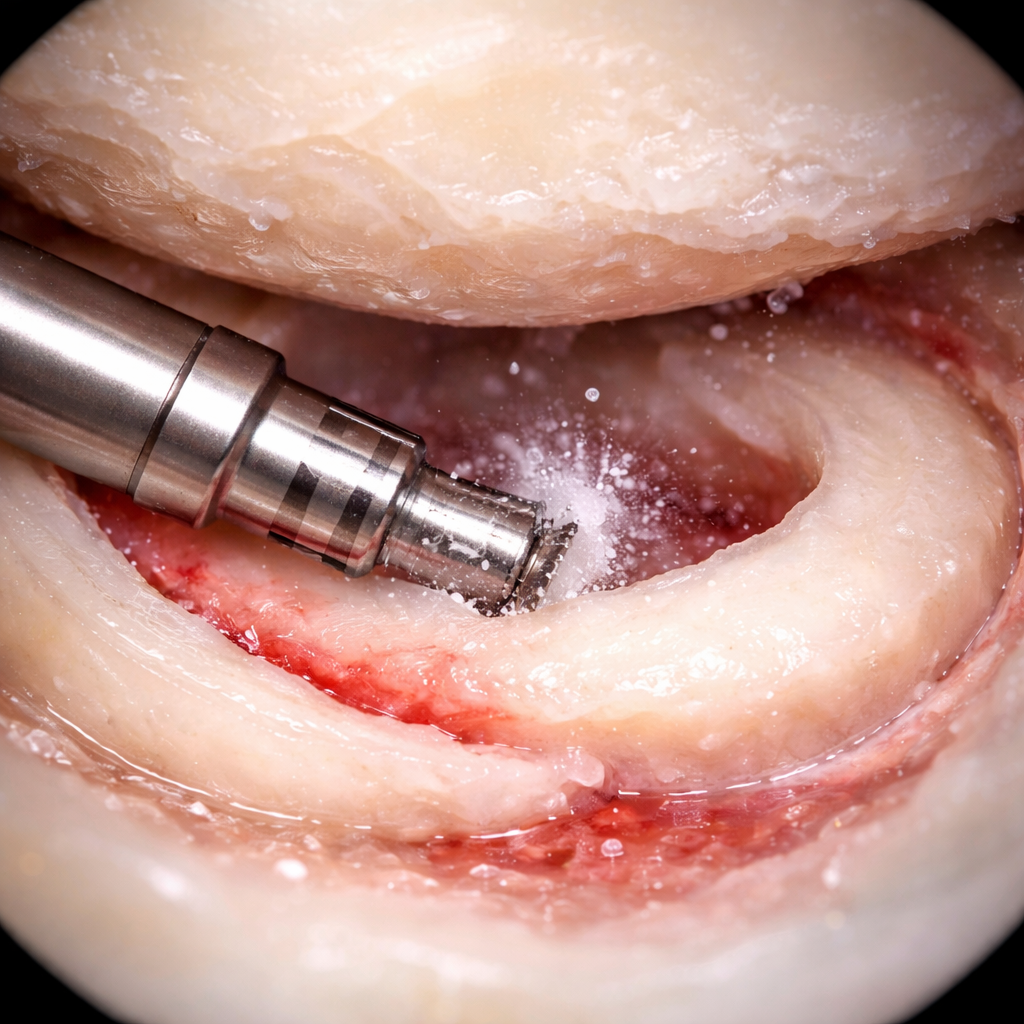
A discoid meniscus is a congenital condition where the lateral meniscus is disc-shaped rather than a crescent, making it highly prone to degenerate tears and mechanical 'clunking.' Dr. Ravi Teja specializes in 'Saucerization'—a precision arthroscopic procedure to reshape the thick tissue into a functional C-shape. While most torn discoid menisci require resection of the thin, degenerated inner portion, we prioritize 'Rim Repair' for thick tissue tears in the vascular capsular junction to preserve the joint's critical shock absorption—which accounts for 70% of the lateral compartment's load distribution.
Surgical Process
Structural Mapping
Using MRI and HD arthroscopy to map the disc extent and identify unstable tears at the capsular junction.
Saucerization
Meticulously trimming and contouring the thick, central disc tissue into a stable, anatomical C-shape rim.
Stabilization
Performing rim repairs or root fixation if the reshaped meniscus shows instability against the joint lining.
Patient Care
Recovery Roadmap
Weight-bearing is gradually resumed using crutches over 2-4 weeks. Patients must avoid deep squatting, sitting cross-legged, or heavy lifting for 4 months. Long-term follow-up includes standing X-rays to monitor joint alignment and cartilage health.
Who Needs This Procedure?
Children or young adults with a persistent 'clunking' or 'snapping' in the knee
Patients with a congenital, disc-shaped meniscus that has started to tear
Individuals experiencing painless but audible joint snaps during bending
Young patients seeking to preserve their lateral meniscus through 'saucerization'
Clinical Results & Gallery
Procedural Intelligence
Elite Patient Care
Dr. Ravi Teja provides personalized evaluations using the latest diagnostic technology for Discoid Meniscus Treatment.
Book EvaluationElite Standard
Certified Excellence
Safety First
Minimal Complications